
Material architecture
Confirm the substrate, active composite, electrode design and protective stack rather than comparing only headline material names.
Nano-carbon heating materials
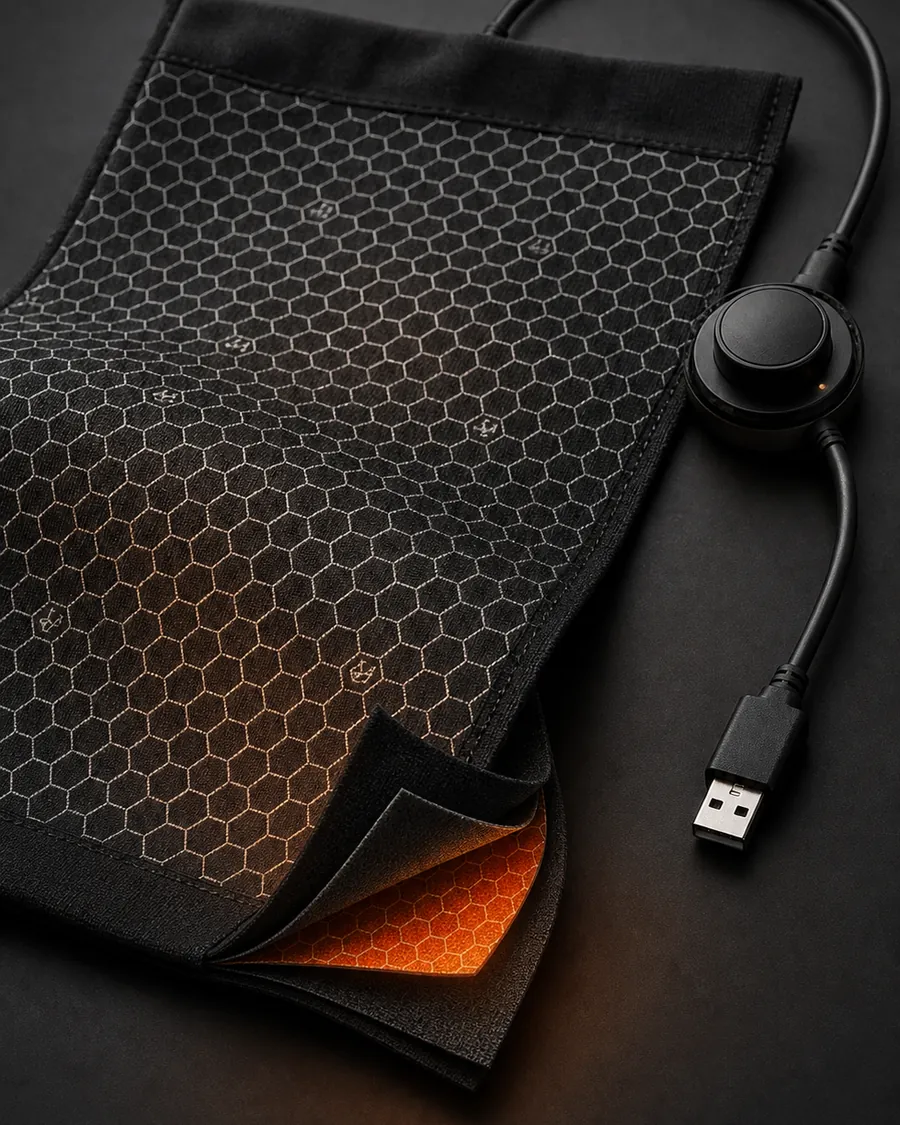
A textile-compatible nano-carbon network turns electrical input into broad, controllable surface heat—then integrates with electrodes, sensing and protection as a complete product architecture.
Engineering context
Buyers often search for graphene heating film, graphene heating elements or CNT heaters as if the material name alone defines performance. In a commercial product, the conductive network, resistance design, electrodes, current path, insulation and control strategy determine how that material behaves.
THERMOVEX uses a CNT and graphene composite approach: carbon nanotubes form a connected conductive framework while graphene supports the network. The material is then engineered into a textile heater or controlled module for the intended voltage, shape and application.
Buyer specification guide
These are the inputs our engineers use to turn a search term or product idea into a testable, production-ready brief.
Confirm the substrate, active composite, electrode design and protective stack rather than comparing only headline material names.
Match resistance to voltage, heated area, current and power so the module reaches the required output without an unsuitable electrical load.
Evaluate the complete surface with thermal mapping; edge conditions, seams, pressure and insulation can change temperature distribution.
Define bend zones, attachment, lead transitions and sewing restrictions around the movement of the final textile product.
Use temperature feedback, output control and electrical protection according to the product risk and user interaction.
Validate the actual production combination of material, geometry, controller, power source and finished-product construction.
Application fit
The use case determines the practical voltage, heater geometry, control strategy, construction and evidence plan.
Distributed heating surfaces that follow garment geometry and preserve movement.
Custom shapes with electrodes, leads, insulation and optional sensing for downstream integration.
Broad-area, low-profile warmth for soft furnishings and bedding architectures.
Heaters combined with NTC sensing, PWM control and application-specific user interfaces.
Development route
Every stage resolves a different technical and commercial risk before the product moves toward volume manufacturing.
Start with the target surface, temperature behaviour, environment and user—not a material buzzword.
Set voltage, resistance, power density, geometry and electrode arrangement as one calculation.
Coordinate insulation, sensing, control, wiring and product construction around the heater.
Use thermal, electrical, mechanical and care testing appropriate to the final use and target market.
Buyer questions
Final specifications, claims and commercial terms are confirmed for the approved product configuration.
Electrical current passes through the engineered conductive network and resistance converts that input into heat across the active surface. The resistance pattern and system design control the practical output.
The THERMOVEX platform described here is a textile-compatible CNT and graphene composite heating architecture. The final module construction is selected around the required flexibility, handling and product integration.
They can be engineered for wearable formats, but suitability depends on the complete design: temperature, skin proximity, insulation, power, flexing, washing, leads, controls and market-specific requirements.
Custom geometry is possible within electrical, electrode, connection, sewing and production constraints. The requested active area is reviewed as part of the module design.
Bring us the product requirement
Share the application, target market, dimensions, power source and expected volume.
Request a Sample →