
Heating geometry
What area needs heat, where may the module bend, and which zones must remain free for seams, pressure points or hardware?
Custom heater engineering
THERMOVEX develops thin, low-voltage textile heating elements and complete heater modules around the geometry, power source, temperature target and care requirements of the finished product.
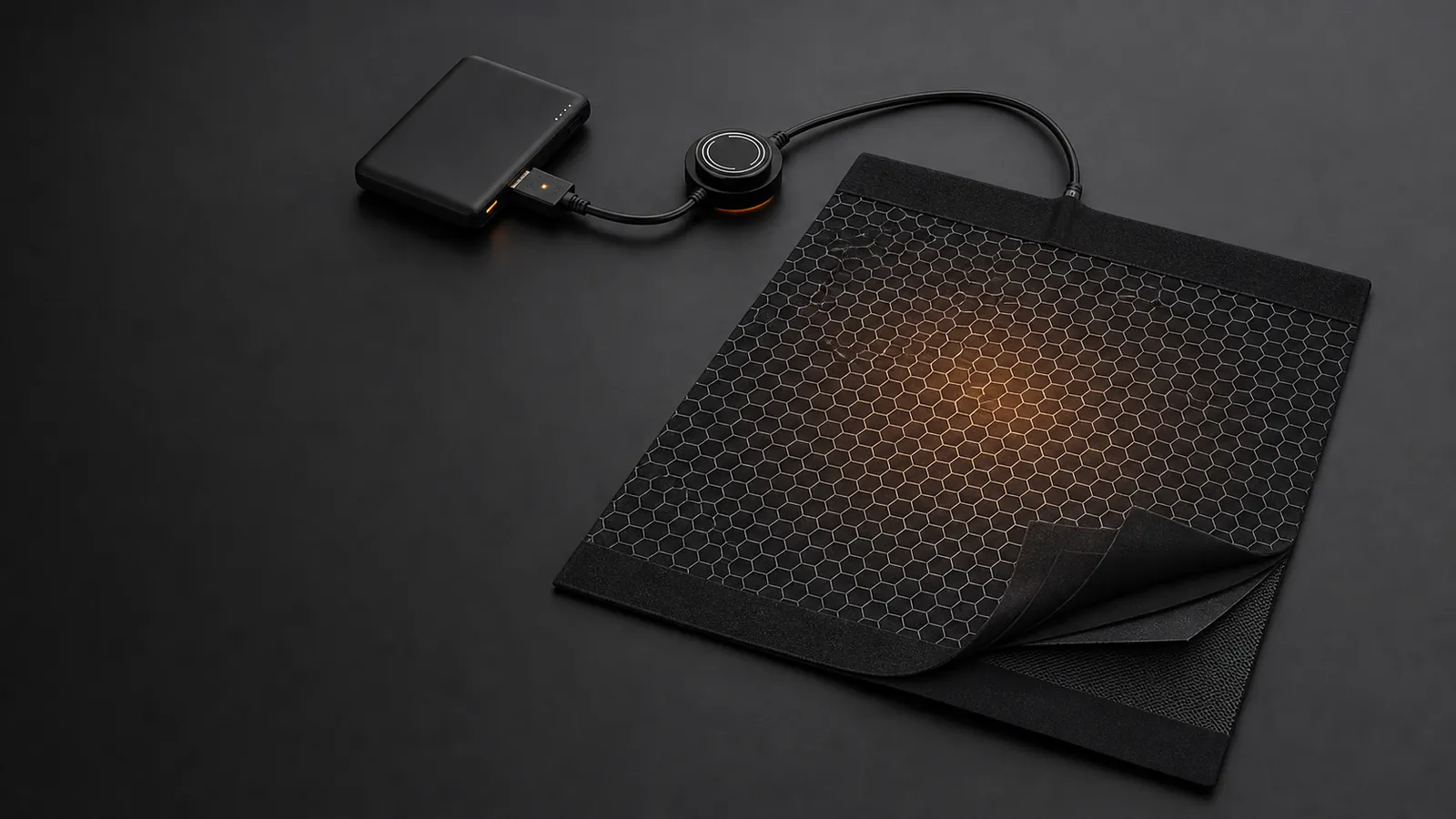
Engineering context
A useful flexible heating element must work inside a real product. Electrical resistance, heater shape, electrode placement, power supply, insulation, sensing and the user's contact with the heated surface all affect the result.
THERMOVEX treats those variables as one thermal architecture. The starting point can be a textile heating material, a custom-cut heater module or a complete controlled system, depending on the customer's engineering scope.
Buyer specification guide
These are the inputs our engineers use to turn a search term or product idea into a testable, production-ready brief.
What area needs heat, where may the module bend, and which zones must remain free for seams, pressure points or hardware?
Define voltage, wattage, connector, battery or mains interface, runtime target and acceptable current draw before fixing the heater pattern.
Choose open-loop power levels or closed-loop sensing according to surface-temperature stability, safety strategy and user interface.
Plan insulation, strain relief, lead routing, removable electronics, care instructions and serviceability with the finished construction.
Confirm thermal mapping, resistance, wash, bend, ingress and market-specific electrical checks for the final product configuration.
Lock the bill of materials, process controls, inspection points and acceptance limits before pilot and scaled manufacturing.
Application fit
The use case determines the practical voltage, heater geometry, control strategy, construction and evidence plan.
Low-profile zones for jackets, vests, gloves, base layers and protective garments.
Broad-area heating for bedding, cushions, throws and other soft comfort products.
Flexible surfaces shaped for seat cushions, interior trim and compact transport applications.
Controlled warmth for non-medical comfort products whose claims and validation are defined by the target market.
Development route
Every stage resolves a different technical and commercial risk before the product moves toward volume manufacturing.
Share product type, dimensions, target market, voltage, temperature range and estimated volume.
Configure the active area, electrical path, electrodes, leads, sensing and insulation stack.
Evaluate fit, warm-up behaviour, surface distribution, comfort and interaction with the finished product.
Confirm the production configuration, evidence plan and repeatable quality controls before volume transfer.
Buyer questions
Final specifications, claims and commercial terms are confirmed for the approved product configuration.
The complete construction—including the active layer, electrodes, leads, insulation and attachment method—must tolerate the intended bending and movement. Flexibility is therefore a module-level design property, not only a material label.
It can be engineered for a defined care method, but washability must be validated on the complete configuration. The heater, lead transitions, connector, controller interface and garment construction all influence the result.
THERMOVEX has reference architectures across 5 V, 12 V and 24 V. The correct choice depends on area, power, temperature, current, power source and the finished product's safety and compliance requirements.
Both routes can be discussed: heating material, custom heater modules, controller-integrated systems and OEM/ODM finished-product development.
Bring us the product requirement
Share the application, target market, dimensions, power source and expected volume.
Request a Sample →